How much is your Pokémon card worth? A UAE price guide in AED
Most price guides quote US dollars and listings that never sold. How to check what your Pokémon card is really worth from the UAE, in AED.
You pulled something good, or you found a shoebox from 2016, and now you want a number. The internet will give you one immediately. It just probably won’t be yours.
Almost every Pokémon price guide is written for an American collector. The prices are in dollars, the comparable sales come from marketplaces that don’t ship here cleanly, and the figure at the top of the page is often an asking price — what somebody hopes to get, not what anybody paid. By the time a card actually reaches Dubai, that number has been through a currency conversion, an international courier, and a customs desk.
This guide walks through the four steps that get you to a defensible AED figure, and is honest about the two places where the answer is usually “less than you’d like.”
This is one part of a larger picture — our complete guide to trading cards in the UAE covers buying, authenticating, grading and selling from here.
The short version
- Identify the card exactly — set, collector number, rarity symbol, language. A one-digit difference can be a 50× difference in price.
- Look up sold prices, not listings. Free tools do this. Asking prices are noise.
- Grade the condition honestly, then read the price for that grade rather than the headline PSA 10 number.
- Convert to AED properly — the peg, then shipping, then 5% duty and 5% VAT if the parcel clears above AED 300.
Most cards land somewhere between “worth less than the sleeve” and “worth a nice dinner.” The rest of this explains how to tell which one you have.
Step 1: Identify the card precisely
This is where most valuations go wrong before they start. “A Charizard” is not a card. There are hundreds of them, separated by enormous gaps in value.
Look at the bottom of the card face. You need four things:
- The collector number — e.g.
199/165. A number higher than the set total means it’s a secret rare pulled from beyond the main set, and those are usually the valuable ones. - The set symbol and expansion code, which tell you which release it came from.
- The rarity symbol in the lower-right corner.
- The language. Japanese and English printings of the same card are separate markets with separate prices.
The Pokémon Company sets out the rarity symbols officially. Since the Scarlet & Violet redesign they run as follows:
| Symbol | Rarity |
|---|---|
| Solid black circle | Common |
| Solid black diamond | Uncommon |
| Solid black star | Rare |
| Two solid black stars | Double Rare |
| Two shiny foil stars | Ultra Rare |
| One shiny gold star | Illustration Rare |
| Shiny gold star (ex / Supporter alt-art) | Special Illustration Rare |
| Three shiny gold stars | Hyper Rare |
Scarlet & Violet also swapped the classic yellow border for grey, which is a fast way to date a card at a glance.
One warning: rarity tells you how hard a card was to pull, not what it’s worth. A Hyper Rare from an over-printed set can be worth less than a Rare from a set nobody bought.
Step 2: Look up what it sold for, not what it’s listed at
An asking price is a hope. A sold price is a fact. This distinction does more work than everything else in this guide combined.
Three free places to find real sales:
PSA Auction Prices Realized (psacard.com/auctionprices) is the strongest free tool for graded cards. PSA opened its auction database to collectors at no cost — it covers results going back more than ten years, updates daily, and sorts by grade, date or price. Its “Summary Prices by Grade” view is the part to use: it shows what the card sold for at each grade alongside how many exist at that grade.
eBay sold listings. Search the card, then filter to Sold items. Ignore everything else on the page. There’s no local eBay for the UAE, so you’ll be reading US results in dollars — which is fine, that’s the reference market.
TCGplayer and PriceCharting are useful for raw, ungraded cards, where PSA’s data doesn’t reach. Both are US-centric.
If a card has only one or two recorded sales, treat the price as an estimate with wide error bars. Thin data is thin data.
Step 3: Grade the condition honestly
Here is the uncomfortable part. The headline price you found is almost certainly for a PSA 10, and your card is almost certainly not one.
Graders assess four things: centering, corners, edges and surface. Pull the card out under good light and look at all four. Check the centering on the back as well — back centering fails more cards than collectors expect. A single soft corner, a faint print line, or a whitening flick along one edge is enough to move a card down a grade.
Rather than apply a rule of thumb, read the actual spread off the PSA “Summary Prices by Grade” table for your specific card. The gap between a 10 and a 9 is not a fixed percentage — on some cards it’s small, on others the 10 sells for several times the 9. It depends on how many 10s exist, which that same table tells you.
If your card is raw and ungraded, price it against raw sales, not slabbed ones. Comparing your loose card to a graded result is the single most common way people talk themselves into a number that isn’t real.
One thing to settle before you get attached to a number: is the card genuine? Every card worth valuing is also worth counterfeiting, and the more valuable it is, the better the fake. Our eight checks for spotting a fake Pokémon card takes about a minute to run.
Step 4: Convert to a real AED number
The dirham is pegged to the US dollar at 3.6725, and the Central Bank of the UAE has held it there since 1997. So the conversion itself is the easy, stable part: a $200 card is roughly AED 735.
What people forget is everything after the conversion.
- Your bank’s markup. The peg is fixed; your card’s FX spread is not. Check what your bank actually charges.
- International shipping and insurance, which on a low-value card can exceed the card.
- Customs. Dubai Customs lowered the duty-free threshold to AED 300 per consignment under Customs Notice 05/2022, effective 1 January 2023 — down from roughly AED 970. Above that, expect 5% duty on the CIF value (goods + insurance + freight), then 5% VAT calculated on the duty-inclusive total.
So a $200 card is not an AED 735 card once it’s in your hands in Dubai. It’s AED 735 plus courier, plus roughly 10% stacked on the declared value, plus whatever your bank took on the way through.
This cuts the other way too. If you’re selling locally, a UAE buyer is comparing your price against that fully landed cost — not against the raw US sold price. That’s the number you’re really competing with.
Should you grade it? The 2026 answer is “probably not yet”
Grading a card usually raises its value. In 2026 it has also become slow and expensive, and UAE collectors feel this more than most because there is no PSA facility here — every submission is an international round trip, either direct or through one of the handful of UAE shops that act as submission intermediaries.
The queue is the real problem. On 2 June 2026 PSA paused new submissions across its four cheapest tiers — Value Bulk, Value, Value Plus and Value Max, which spanned roughly $24.99 to $64.99 per card — after a demand spike pushed its active backlog toward 10 million cards. Regular service, reported at $74.99 per card at the time of the pause, became the cheapest tier you could actually order. PSA has said the Value tiers won’t reopen until the backlog falls to around 5 million.
It hasn’t yet. PSA’s public backlog tracker showed 11.85 million units on 11 August 2026, after what the company described as a record grading month in July. The direction is finally right; the distance is still large. Check PSA’s live pricing page before you budget anything — both prices and availability have moved repeatedly this year.
Rough per-card math from Dubai, using Regular service:
| Line item | Estimate |
|---|---|
| Grading fee (~$75) | ~AED 275 |
| Round-trip courier, insured — assumption, get your own quote | ~AED 300 |
| Duty + VAT on the return leg | ~10% of declared value |
| Time | 40–50 business days, plus shipping |
That’s comfortably north of AED 600 per card before your card has proved anything. Two conclusions follow:
- Grading one card alone rarely pays unless it’s worth well into four figures raw.
- Grading a batch changes the maths, because the courier cost — the expensive half — spreads across every card in the parcel.
If you have one good card and nothing else, waiting is a legitimate strategy. The full grading breakdown from the UAE is here, including how the other graders compare now that PSA’s cheap tiers are shut.
What the UAE market actually looks like right now
Guides written elsewhere describe a market that doesn’t quite exist here. So here’s the local picture, taken from live House of Stox listings on 27 August 2026:
- 167 Pokémon products listed, of which 87 carried a live seller-set ask in AED.
- 135 were sealed product — booster boxes, Elite Trainer Boxes, bundles, tins, blisters, decks. Of those, 84 had a live ask, ranging AED 75 to AED 7,500, with a median of AED 450.
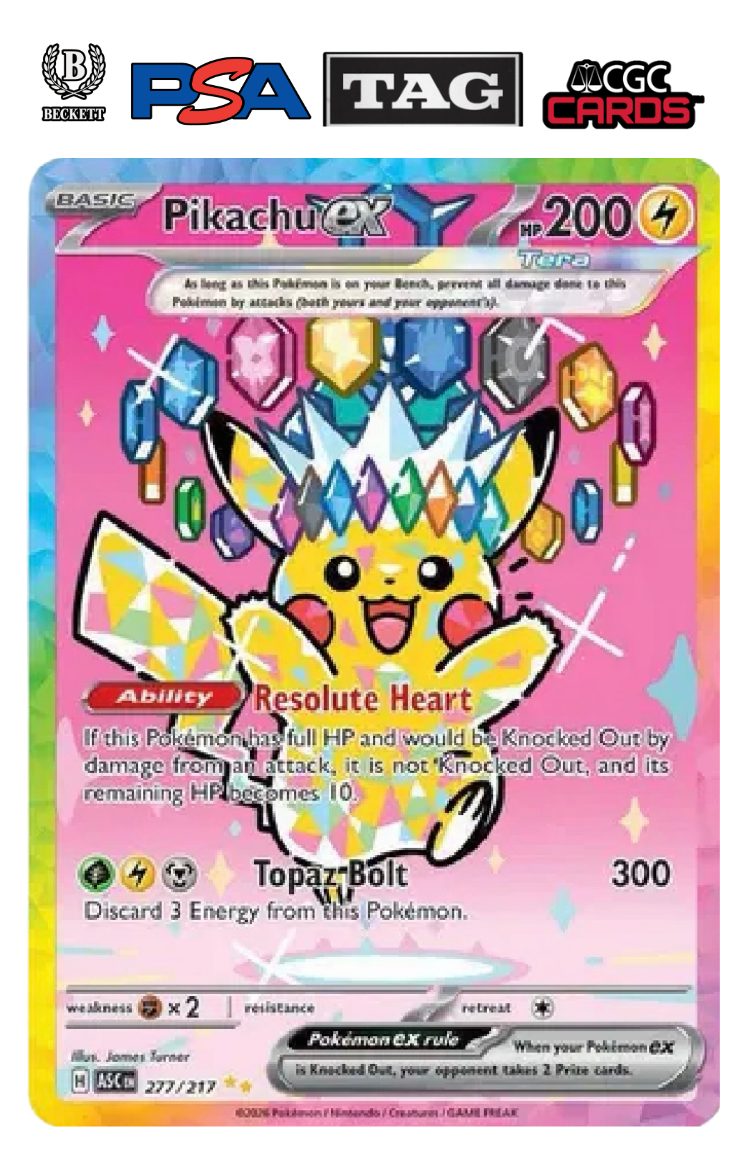
- 32 were raw singles, and only 3 of those had a live ask — a Pikachu EX Special Illustration Rare at AED 1,899, a Mega Diancie EX at AED 300 and an Erika’s Tangela Illustration Rare at AED 150. Every one was a modern Illustration Rare or Special Illustration Rare from a 2026 Mega Evolution set.
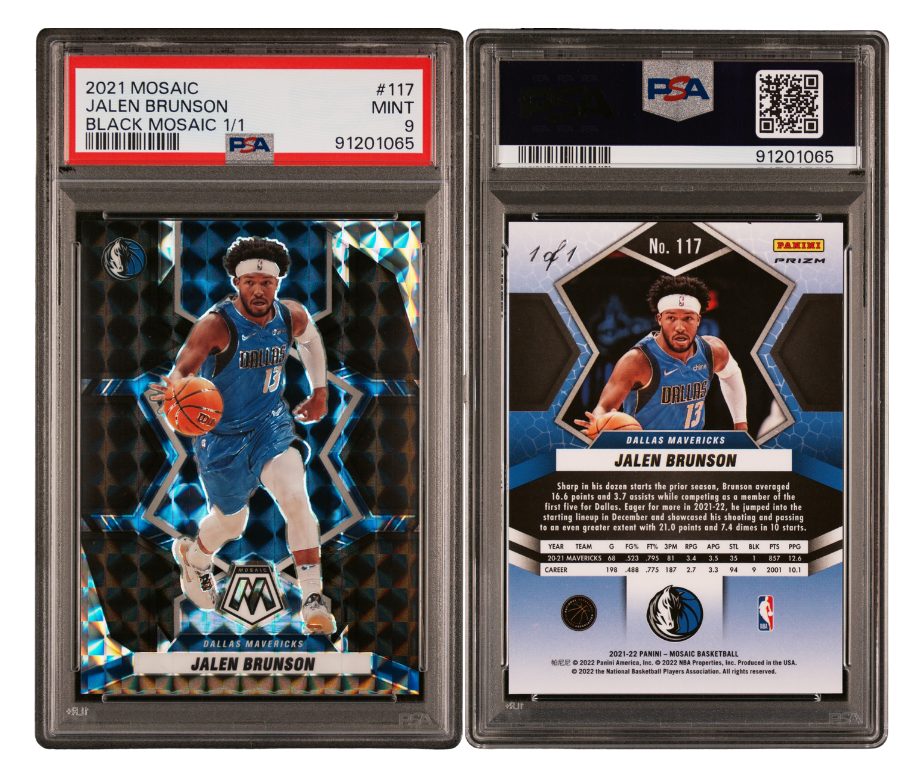
- Graded slabs are essentially absent. Across the entire catalogue there was a single PSA-graded card, and it was a basketball card, not a Pokémon one.
Two things follow for anyone valuing a card in the UAE.
First, the local market is sealed-product led. Boxes and ETBs have real, visible AED prices. That’s a genuine reference point, and it’s denominated in the currency you actually spend.
If your reason for valuing the card is that you intend to sell it, the venue you pick moves the number as much as the card does — here are the six routes and what each actually pays.
Second, if you’re holding a single, you’re valuing something that doesn’t yet have a deep local order book. Your reference prices are still coming from the US market, which drags you straight back into the conversion and customs maths above. That’s not a reason to write the card off — it’s a reason to be sceptical of anyone quoting you a confident local number for it.
The five things that move the number most
- Print run. Sets printed heavily during a boom stay cheap almost regardless of rarity. Scarcity is about supply, not the symbol. This is why the genuinely valuable cards are overwhelmingly things that were never sold at retail in the first place.
- Condition. On a chase card, the gap between grades can dwarf every other factor.
- The character. Charizard, Pikachu and a short list of others carry a premium that has nothing to do with rarity and everything to do with demand.
- Language and printing. Japanese, English and other-language versions trade independently.
- Sealed versus opened. Sealed product is priced on what might be inside. Once it’s open, that premium is gone permanently.
Common mistakes
- Pricing off active listings. Anyone can list a card at AED 10,000. That tells you nothing.
- Comparing a raw card to a PSA 10 result. Different products, different prices.
- Assuming old means valuable. Most 1999-era cards are commons in played condition, and they’re worth very little.
- Forgetting the landed cost. A US price is not a UAE price.
- Ignoring the grading queue. A valuation that assumes a fast, cheap slab is a valuation built on 2021 conditions.
Questions people actually ask
Is there a free Pokémon card price checker? Yes. PSA’s Auction Prices Realized database is free and covers graded sales going back over a decade. For raw cards, use eBay sold listings and TCGplayer. You don’t need a paid tool.
Why is my card worth less than the price I found online? Usually one of three reasons: the price you found was an asking price, it was for a higher grade than your card, or it was for a different printing of the same character.
Do I need to grade a card before selling it in the UAE? Not necessarily. Given current PSA costs and turnaround, grading only clearly pays on high-value cards or on batches large enough to spread the shipping.
Are Japanese cards worth more? Sometimes, and they’re a separate market. Japanese print quality is often praised by graders, but demand differs card by card. Price them against Japanese sales, not English ones.
How often do these prices change? Constantly. A reprint, a new set, or a shift in a grading population report can move a card in a week.
Treat any figure you arrive at as a snapshot rather than a settled value — including the ones in this article. The listing data above was accurate on the day it was pulled, PSA’s queue moves every fortnight, and the market reprices itself every time a new set lands. What doesn’t change is the method: identify the card exactly, price it off real sales at its real grade, and finish the sum in the currency you’ll actually be paid in.
Sources: rarity symbols and card layout via Pokémon.com; auction database details via PSA; grading pause and backlog figures via Sports Collectors Daily and Baseball America; UAE customs threshold via EY on Dubai Customs Notice 05/2022; dirham peg via the Central Bank of the UAE.
Buy and sell authenticated, in the UAE
Every item verified before it ships. Fast delivery across the Emirates.