Trading cards in the UAE: a complete guide for 2026
What trades in the UAE, what it costs in AED, and how to buy, value, authenticate, grade and sell cards from Dubai — with live market data.
Most guides to collecting trading cards are written for an American audience, and they quietly assume things that aren’t true here: that grading is a fortnight away, that eBay is your local marketplace, that prices are in dollars, and that customs is somebody else’s problem.
This guide is written for the UAE. It covers what actually trades here, what it costs in dirhams, and the five things every collector eventually has to do — value a card, verify it’s real, decide about grading, buy well, and sell without giving away money.
Where there are numbers, they come from live listings pulled on 27 August 2026 rather than from estimates.
What the UAE market actually looks like
Here’s the collectibles market as it stands locally:
| Metric | Figure |
|---|---|
| Collectibles products listed | 486 |
| With a live seller-set ask in AED | 287 |
| Ask range | AED 75 – 18,000 |
| Median ask | AED 350 |
| Under AED 250 | 36% of live asks |
| AED 250–499 | 24% |
| AED 500–999 | 13% |
| Above AED 1,000 | 28% |
By brand volume: Pokémon (167), Funko (100), Panini (82), Pop Mart (30), LEGO (29), Topps (28).
Three things follow from this, and they shape everything else in this guide.
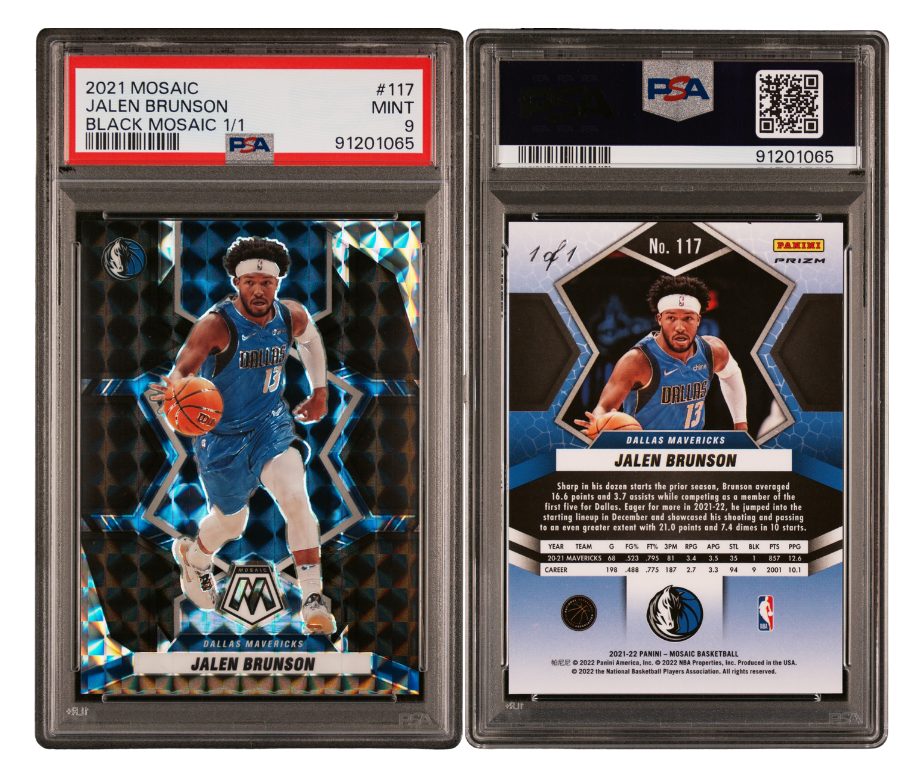
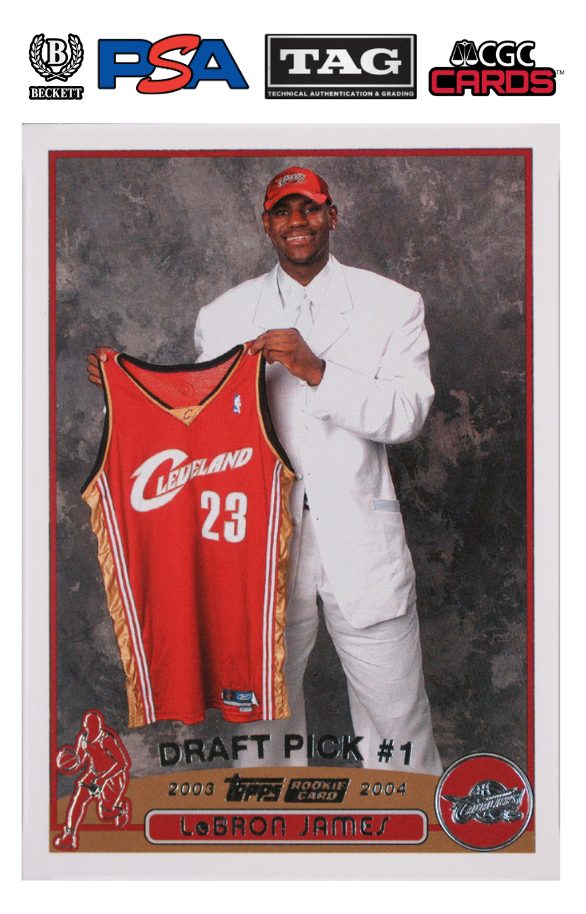
This is an accessible market with a real top end. A median ask of AED 350 and six in ten listings under AED 500 describes a hobby people participate in rather than an asset class — but the tail is not trivial: a Panini Mosaic Jalen Brunson 1/1 in a PSA 9 at AED 18,000, a 2003-04 Topps LeBron rookie at AED 6,600, and roughly a quarter of live asks above AED 1,000, most of them sealed Pokémon boxes and modern sports cards.
It’s led by Pokémon and by sealed product. Of 167 Pokémon products listed, 87 carried a live ask. 135 were sealed — booster boxes, Elite Trainer Boxes, bundles, tins, decks — with live asks running AED 75 to AED 7,500 at a median of AED 450. Only 32 were raw singles, and just three of those had a live ask.
Almost nothing is graded. Across the entire catalogue there was a single PSA-slabbed card. That one fact explains more about how to buy and sell here than any other.
Buying: where and how
The venues
Local card shops are the most reliable place to see product in person and to build a relationship, which matters more in a small market than a large one.
Conventions and card shows have become a genuine part of the calendar. Sandbox Swapmeet at Dubai World Trade Centre expected more than 16,000 visitors across four days in 2026, with trading card tournaments in the programme. Dedicated TCG conventions have followed, one debut drawing over 3,000 attendees and 43 vendors. These are the best environments for price discovery, because you can take competing offers in a single afternoon.
Community groups on Instagram, WhatsApp and Discord are where a lot of local trading actually happens. Best prices, least protection.
Online marketplaces solve the verification problem, which in a market this raw is the binding constraint.
Cross-border gives you access to depth the local market can’t match, at the cost of shipping, duty and time.
The cost of buying from abroad
If you import, the arithmetic is fixed and worth memorising:
- AED 300 duty-free threshold per consignment, lowered from roughly AED 970 under Dubai Customs Notice 05/2022, effective 1 January 2023.
- 5% duty on the CIF value — goods plus insurance plus freight. Shipping is inside the taxable base.
- 5% VAT on the duty-inclusive total, so it compounds slightly: about 10.25% all in.
- Plus your bank’s FX markup on the dirham’s fixed 3.6725 peg to the dollar.
A US price is never your price. That’s the single most common error in this market.
Valuing a card
The method is short and most people get it wrong at step one.
- Identify the card exactly — set, collector number, rarity symbol, language, edition. A one-digit difference in the collector number can mean a 50× difference in price.
- Look up sold prices, not listings. PSA’s Auction Prices Realized database is free and covers graded sales going back over a decade. eBay’s Sold items filter covers the rest. An asking price is a hope.
- Price it at its real grade, not at the headline PSA 10 number your card almost certainly isn’t.
- Convert honestly, including the landed cost above.
→ The full valuation guide, with worked AED examples
And if you want to know where the ceiling actually is — the verified records, and which realistically-ownable cards are genuinely worth money — that’s here.
Authenticating
In a market where almost everything is raw, the buyer does the checking. That’s not a complaint about the UAE market; it’s a description of it, and it’s the reason authentication skill has more value here than in a market saturated with slabs.
The Pokémon Company’s own first piece of advice is about price rather than the card: a price dramatically below market is close to a guarantee of a counterfeit, and it reports the highest instances of counterfeit sales coming from informal, cash-based venues.
Beyond that, the physical checks — the light test for the opaque black core layer, the texture test on modern rares, print quality under magnification, typography, the back of the card, and verifying the collector number exists in the official database — will catch most fakes. They will not catch the best ones, and being clear about that limit is part of doing this properly.
→ Eight checks for spotting a fake Pokémon card
Grading
The honest summary for a UAE collector in 2026: grade high-value cards, grade in batches, or don’t grade.
There is no grading facility in the country, so every submission is an international round trip, and the return leg is a taxable import of your own card. PSA paused its four cheapest tiers on 2 June 2026 against a backlog that stood at 11.85 million units on 11 August 2026, leaving Regular — reported at $74.99 — as the cheapest orderable tier. Add courier both ways and customs and a single-card submission from Dubai runs north of AED 600, over several months.
Shipping is the dominant fixed cost, and it barely changes between one card and twenty. That’s the whole argument for batching.
→ Grading from the UAE: costs, queues and whether it’s worth it
Selling
Every route trades price against speed and certainty, and the default — accepting the first offer from the first buyer — is almost always the most expensive.
| Route | Speed | Typical price | Risk to you |
|---|---|---|---|
| Card shop | Same day | Lowest | Very low |
| Card show | Event dates | Mid to good | Low |
| Community groups | Days | Good | Highest |
| Classifieds | Days to weeks | Mid | Moderate |
| Authenticated marketplace | Days to weeks | Good | Low |
| Cross-border | Weeks | Best on high value | Moderate |
The two mistakes that cost sellers the most: selling a collection as one lot — buyers price mixed lots off the worst cards, not the best — and accepting the first offer without getting a second.
→ Where to sell Pokémon cards in Dubai
Starting a collection here
If you’re beginning rather than valuing something you already own:
Collect what you like. The market data above should make this easy to accept — with a median ask of AED 350 and most of the value sitting in sealed modern product, this is an affordable hobby and a poor investment vehicle for most participants. The people who do well financially are generally the ones who would have collected anyway.
Start with sealed, modern product. It’s what the local market carries in depth, it’s priced transparently in AED, and it’s the lowest-risk category for authenticity. Sealed listings run AED 75 to AED 7,500 with a median of AED 450, and a booster box or Elite Trainer Box typically sits between AED 250 and AED 1,000.
Learn to identify cards before you learn to value them. Set symbol, collector number, rarity symbol. Everything else depends on it.
Buy protection immediately. Penny sleeves and top-loaders cost almost nothing relative to the damage they prevent. A card handled carelessly for a month can lose most of its grade.
Go to an event. Handling real cards next to people who know them is worth more than any amount of reading — especially for authentication, where the texture and print-quality checks require a reference you can only build by touching genuine cards.
What’s different about collecting here
Worth stating plainly, because it changes decisions:
Depth is the constraint, not access. You can get almost anything into the UAE. What you can’t do is find a deep local order book for a specific vintage single. That thins out both directions — less competition when you buy something unusual, less liquidity when you need to sell it.
Raw is the default. Which raises the value of authentication skill, and raises the premium a slab commands when one does appear.
Sealed leads singles. The reverse of mature markets, and a reasonable reflection of a collector base that’s grown quickly in the last few years.
Your reference prices are foreign. Which means every valuation carries a currency and customs step that guides written elsewhere simply don’t have.
Questions people actually ask
Are trading cards popular in the UAE? Increasingly. The event calendar has grown into something substantial, and Pokémon is the largest single brand by listing volume locally.
Where can I buy Pokémon cards in Dubai? Local card shops, conventions, community groups, online marketplaces, and cross-border. Each trades price against certainty differently.
Do I pay customs on cards shipped to the UAE? Above AED 300 per consignment, expect 5% duty on CIF plus 5% VAT on the duty-inclusive total.
Can I get cards graded in the UAE? Submitted, not graded. UAE shops act as intermediaries for overseas graders. The grading happens abroad.
Is it cheaper to buy cards locally or import them? On sealed modern product, usually locally — the median ask is AED 450 and there’s no customs step. On specific vintage singles, you’ll often have no local option at all.
Numbers here are a snapshot from a single day, and this market moves quickly — PSA’s queue is republished every fortnight, new sets reprice the sealed market on release, and the local catalogue changes weekly. Treat the figures as the shape of the market rather than a price list. What holds is the method: identify precisely, price off real sales, verify before you pay, and count the landed cost every time.
Sources: convention figures via The National; counterfeit guidance via Pokémon Support; PSA grading pause and backlog via Sports Collectors Daily and Baseball America; UAE customs threshold via EY on Dubai Customs Notice 05/2022; listing data from the House of Stox catalogue, 27 August 2026.
Buy and sell authenticated, in the UAE
Every item verified before it ships. Fast delivery across the Emirates.