Getting a card graded from the UAE: costs, queues and whether it's worth it
No PSA facility in the UAE and the cheapest tiers are paused. What grading a card from Dubai costs, how long it takes, and when to skip it.
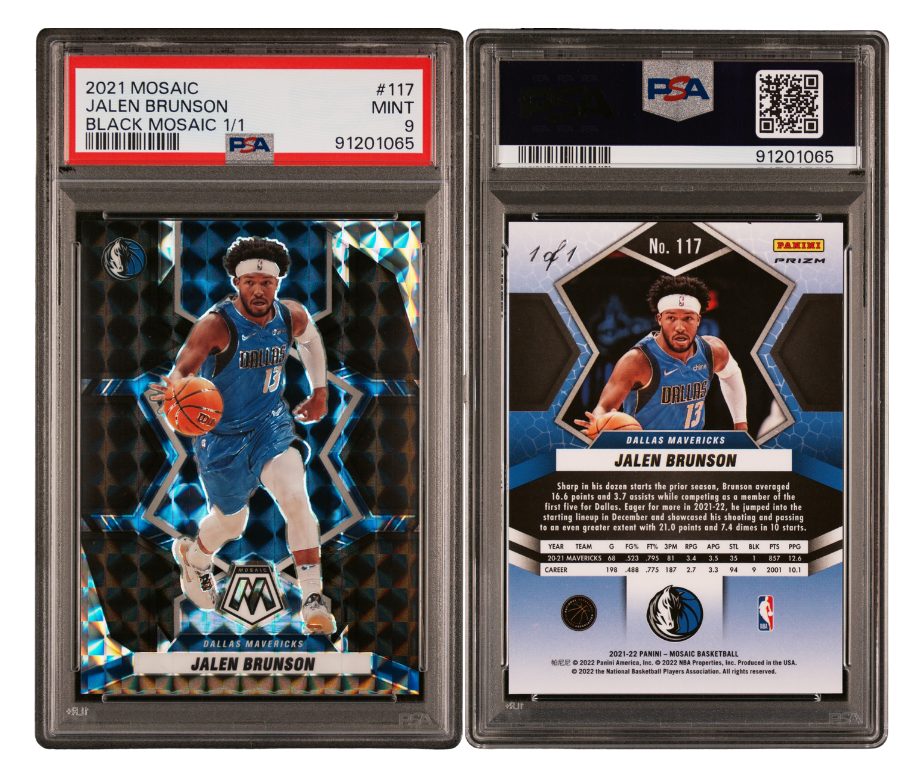
Grading turns an opinion into a fact. A raw card is worth whatever two people can agree on. A graded card carries a number from a third party, sealed in a tamper-evident slab, and that number is what the market prices against.
That’s the case for grading, and it’s a good one. The case against it, in 2026, is that the industry is jammed — and if you’re submitting from the UAE, you’re paying an international courier twice for the privilege of joining a queue millions of cards long.
This is what the process actually looks like from here, what it costs in AED, and the threshold below which it isn’t worth doing.
Grading is one decision among several — our complete guide to trading cards in the UAE covers the rest.
The two problems specific to the UAE
There is no grading facility in the country. PSA, CGC, Beckett and the rest all grade elsewhere. Every submission from Dubai or Abu Dhabi is an international round trip: your card flies out, sits in a queue, and flies back. A handful of UAE shops act as submission intermediaries, bundling local collectors’ cards into group submissions — that’s convenience and shared shipping, not a local grading service.
You import your own card back. The return leg is a commercial import as far as customs is concerned. Dubai Customs lowered the duty-free threshold to AED 300 per consignment under Customs Notice 05/2022, effective 1 January 2023. Above that, expect 5% duty on the CIF value, then 5% VAT on the duty-inclusive total. A card that was yours when it left is a taxable import when it returns.
Neither of these is a reason not to grade. They’re reasons the maths is different here than in the guides written for American collectors.
The queue is the real cost in 2026
PSA paused new submissions across its four cheapest tiers — Value Bulk, Value, Value Plus and Value Max, spanning roughly $24.99 to $64.99 per card — on 2 June 2026. The trigger was a demand spike that pushed its active backlog toward 10 million cards. Regular service, reported at $74.99 at the time of the pause, became the cheapest tier you could actually order.
PSA has said the Value tiers reopen when the backlog falls to around 5 million. Its public tracker showed 11.85 million units on 11 August 2026, following what the company called a record grading month in July. The queue is finally shrinking. It is not close to the reopening threshold.
This matters more than the headline price. A cheap tier you cannot order is not a cheap tier.
The other graders, and why the choice narrowed
There’s a structural story behind the congestion worth knowing before you pick a company.
Collectors — PSA’s parent — acquired SGC in early 2024 and subsequently reached a deal to acquire Beckett. That would put three of the four major grading companies under one owner. In January 2026, US Congressman Pat Ryan asked the Federal Trade Commission to investigate, arguing the roll-up had “effectively dismantled market competition” and that the combined company could control more than 80% of grading volume. He pointed to SGC’s post-acquisition trajectory, where grading volume fell 61% in two months.
Whatever the FTC concludes, the practical effect for a collector in Dubai is simple: CGC is the one major grader still independently owned. When PSA’s cheap tiers close, there are fewer places for that volume to go than there used to be — which is part of why waiting times across the board have stretched.
| Grader | Position in 2026 |
|---|---|
| PSA | Highest resale premium; cheapest tiers paused since 2 June |
| CGC | Independent; strong with modern Pokémon; open when PSA’s Value tiers are not |
| Beckett (BGS) | Subgrades on the slab, Black Label for four 10s; under acquisition by Collectors |
| TAG | Computer-vision grading with a photographic report showing where points were lost |
A PSA slab generally resells for more than the same card in another company’s holder. That premium is real, and it’s the reason people queue. It is not infinitely large, and on a mid-value card it will not cover an $80 grading fee plus two courier legs.
What it actually costs from Dubai
Here’s the per-card sum using PSA Regular, which is the cheapest PSA tier currently orderable.
| Line item | Estimate |
|---|---|
| Grading fee (~$75) | ~AED 275 |
| Courier out, tracked and insured — assumption, get a quote | ~AED 150 |
| Courier back, tracked and insured — assumption, get a quote | ~AED 150 |
| Duty + VAT on the return leg | ~10% of declared value |
| Rough total per card, single submission | AED 600+ |
| Time | 40–50 business days, plus shipping both ways |
The courier figures are placeholders — get your own quotes, because they move with weight, declared value and destination. Everything else is either published or arithmetic.
Two things fall out of this table.
Shipping is the expensive half, and it doesn’t scale with card count. Sending one card costs roughly what sending twenty costs. This is the single most important fact about grading from the UAE: the per-card cost collapses as the submission grows.
Declared value cuts both ways. Declare low and you save on duty but cap your insurance — if the parcel is lost, that’s your compensation. Declare honestly.
So when is it worth it?
This decision starts with knowing what the card is worth raw, so value it properly first. Then apply rough guidance rather than a rule, because it depends on the card:
- Under about AED 400 raw — almost never worth grading individually. The fees and shipping approach or exceed the card.
- AED 400 to AED 1,500 raw — only as part of a batch, and only if the card has a genuine shot at a 9 or 10. A mid-grade result on a mid-value card usually loses money.
- Above AED 1,500 raw — grading generally pays, provided the card is clean. The higher the value, the more the slab premium dominates the fixed costs.
- Any card where authenticity is genuinely in question — grade it regardless of the maths, or don’t buy it.
The condition test matters as much as the value test. Grading a card you already know has a soft corner buys you an expensive, slow confirmation of what you could see for free.
Before you send anything: pre-grade it yourself
Graders assess four things — centering, corners, edges and surface. Spend ten minutes with the card under a bright light before you spend AED 600 on it.
- Centering. Check the front and the back. Back centering fails more cards than people expect, and it’s the one most collectors never look at.
- Corners. Any softness, fraying or whitening under magnification.
- Edges. Run your eye along all four for nicks and whitening flicks, which show up hardest on dark borders.
- Surface. Tilt the card under light. Print lines, scratches and dimples only appear at an angle.
If you find something at this stage, you’ve saved yourself the fee. If you don’t, you at least know what you’re paying for.
A note on cleaning: don’t. Attempting to improve a card’s surface risks damage that’s obvious to a grader, and altered cards get rejected rather than graded.
Getting it there safely
- Penny sleeve, then a semi-rigid holder. Not a top-loader for most submission types — check the grader’s current packing requirements, which change.
- Never use tape on the holder. Removing it is where cards get damaged.
- Rigid outer packaging, card immobilised so it can’t slide.
- Tracked and insured courier both ways. This is not the place to save AED 40.
- Keep the submission paperwork and the tracking number. You’ll need them for the customs declaration on the return leg.
What this means for buying and selling here
A practical consequence for the UAE market: because grading is slow and expensive from here, most cards circulating locally are raw. Across the House of Stox catalogue on 27 August 2026 there was a single PSA-graded card listed — a basketball card, not a Pokémon one.
If you’re buying raw locally, you’re taking on the condition and authenticity assessment yourself. That’s fine if you know what you’re looking at — start with the eight checks for spotting a fake — and it’s the reason the four-point condition check above is worth learning properly.
If you’re selling, that scarcity is the opportunity. In a market where almost everything is raw, a slabbed card is doing work that no photograph and no description can do — it removes the buyer’s doubt entirely. That’s precisely why the premium exists, and why it tends to be larger in thin markets than in deep ones.
Questions people actually ask
Can I get a card graded in Dubai? Not graded — submitted. UAE shops act as intermediaries and send cards abroad in group submissions. The grading itself happens overseas.
Which grader should I use? PSA if the card is valuable enough to justify the queue and the resale premium. CGC if you want a professional grade at lower cost and shorter waits, particularly on modern Pokémon.
How long does it take from the UAE? Budget the grader’s stated turnaround plus shipping both ways plus customs clearance. On PSA Regular that realistically means several months door to door.
Will grading always increase my card’s value? No. A low grade can confirm a card is worth less than the owner hoped, and the fee is spent either way. Grading adds value when it converts uncertainty into a high number.
Is it cheaper to send a batch? Substantially. Shipping is the dominant fixed cost and it barely changes between one card and twenty.
The economics here move constantly — PSA’s queue is republished every fortnight, tier availability has changed repeatedly this year, and courier rates are quoted fresh each time. Verify prices and turnaround on the grader’s own site before you commit. The framework holds even when the numbers don’t: grade for value or grade for certainty, batch whenever you can, and check the card honestly before you pay anyone to check it for you.
Sources: grading pause and backlog figures via Sports Collectors Daily and Baseball America; industry consolidation and FTC request via Congressman Pat Ryan’s office and cllct; UAE customs threshold via EY on Dubai Customs Notice 05/2022.
Buy and sell authenticated, in the UAE
Every item verified before it ships. Fast delivery across the Emirates.